Letter From Belfast
Reflections on the 19th Meeting of the Anglican Consultative Council

At the end of June, I travelled to the 19th meeting of the Anglican Consultative Council which was held this year in Belfast, in Northern Ireland. There was a little grumbling about just how long the drive from the sunny West End of Glasgow to the ferry port at Cairnryan feels on a Saturday afternoon, but those grumbles turned out to be rather small potatoes beside many of the other delegates. We had come together from provinces as far flung as the Church of the Province of the Indian Ocean and the Church of England. A bishop had been travelling for three days — and his suitcase continued to trail behind him for another four days. A number of delegates had crossed the whole world, and had then been trapped 400 miles away due to thunderstorms grounding flight connections from London. Some had left active war zones to be there. Our friends from the Democratic Republic of Congo had been unable to travel due to the outbreak of Ebola in their country. Before we had done a single piece of business, the vastness of the Anglican Communion had become a tangible thing.
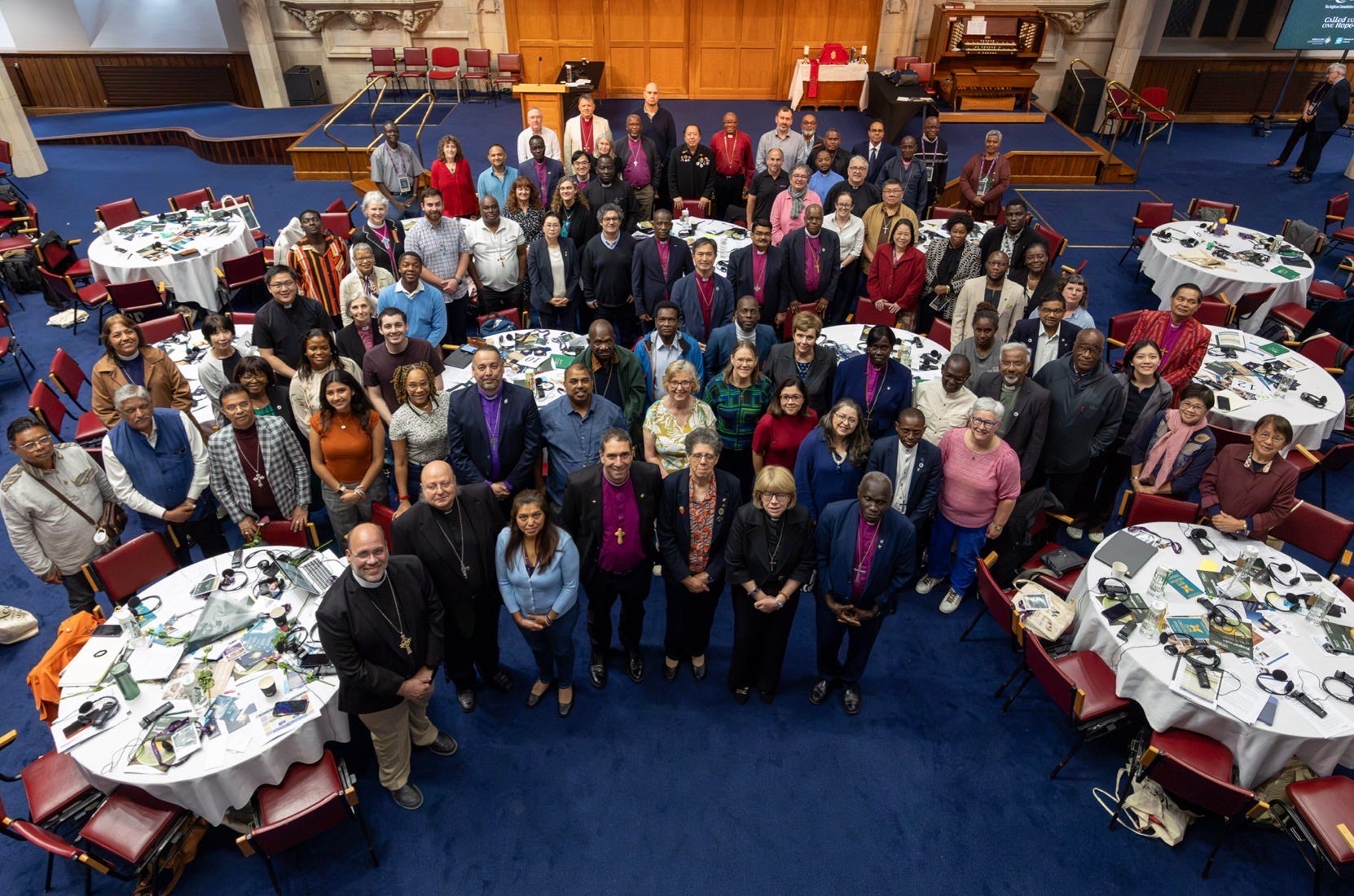
The Anglican Counsultative Council is one of the four Instruments of Communion. The other three Instruments of Communion are the Primates’ Meeting, the Lambeth Conference, and the Archbishop of Canterbury. These are the structural elements which indicate membership of the worldwide Anglican Communion, through their being recognised or participated in by each Member Church. The Anglican Consultative Council, or the ACC, is the only Instrument of Communion that includes lay people and ordained people who are not bishops in its membership. As one of the smaller provinces, Scotland sends two representatives: a lay person, and an ordained person who is not a bishop.
The Nairobi Cairo Proposals
The main piece of business for ACC-19 was to discuss a piece of work called the Nairobi-Cairo Proposals, which had been put together by IASCUFO, the Inter-Anglican Standing Committee on Unity, Faith, and Order.
At ACC-18, which took place in Ghana in 2023, a proposal had been put by IASCUFO and welcomed by the Council “to explore theological questions regarding structure and decision-making to help address our differences in the Anglican Communion”. The question that was being asked was, how do we find a way forward for the Anglican Communion in a way that recognises and respects the fact that we do not all agree with each other? This proposal had been welcomed by the Council, and IASCUFO had been asked to proceed with this work, to report back to the Instruments of Communion, and to bring any proposals back for discussion to ACC-19. The result of their work was the Nairobi-Cairo Proposals.
In Scotland, we had done our homework quite thoroughly through several months of discussions with the Primus, the Inter-Church Relations Committee, and the current and former representatives to the ACC, and eventually with the General Synod just a few weeks before ACC-19 got underway. We had noted a number of issues with the proposals, and had put together an amended text which addressed some of those concerns. The only other provinces to have submitted a written response were the Church of England, the Anglican Church in Brazil, and the Anglican Church of South America. It had been the sense amongst some of us in the Scottish Episcopal Church that perhaps this lack of response from other provinces meant that they were broadly in agreement with the proposals. I had arrived in Belfast — and, indeed, been sent to Belfast — prepared to need to make myself difficult, which would hardly have been a new experience for me.
Bewildering Processes
It is an unsettling experience to enter any sort of new environment with little idea of how things work or what you ought to expect. It’s like the first day at school, or the first day on General Synod — except that my first day on General Synod was in 2013, so it’s been a while since I’ve felt so completely out of my comfort zone. I’ve spent enough time in meetings of the various governing bodies of the Scottish Episcopal Church that I’ve learned how to get a piece of business onto the agenda, how to propose an amendment, how the voting works, what the rules of order are and how to object when they are being broken, and so on. At the ACC, I was learning all these things again from scratch and I was doing it in the context of having my mind blown by the things I was learning from around the Communion.
The Anglican Communion, Gathered
On the morning of Sunday 28 June, I found my assigned table for the week, made up of delegates from the Anglican Church of Tanzania, the Church of South India, the Church in the Province of the West Indies, the Church of Pakistan, and the Scottish Episcopal Church. Our time together was shaped by worship, through Morning and Evening Prayer with liturgy from the Church of Ireland and through a daily Eucharist which was offered by turns in Spanish, in Portuguese, in Swahili, and in French. We began each day with bible study, and then with sharing stories from our churches — our challenges, our structures, the things that we were proud of, the things that we want to do better. In the afternoons we rotated around different tables to share conversation and learning about evangelism, about refugees, about the environment.
We ate together, mingling with representatives from other provinces. In my hotel, I’m sure that the few people staying there who were not part of the ACC delegation were baffled all week about why at breakfast there were always priests and bishops as far as the eye could see. But I never sat down to a meal or a cup of coffee without finding that I was next to someone with whom I had something in common, usually a mutual friend. I learned how strong the affection is across the Anglican Communion for Bishop Mark, and how fondly my predecessors on the ACC, Alistair Dinnie and Lee Johnston, are remembered by their friends who are still serving. The Anglican Communion is massive and complicated, but it is also so small and the bonds of affection that hold us together are very real.
The conversations I had over the course of the week were life and faith changing. I’m not sure we’ve talked about the environment until we have had that conversation with someone whose church is literally on an island that is disappearing under the ocean, or with someone whose prayers every week are shaped around the need to give thanks for water. A discussion about refugees and migration sounds very different when some of the people at the table are from countries where there is active conflict. I met someone who is in the process of moving back to their home country, to a country that is currently at war, because it is, in their words, “still home”. And at the table I shared the most time with, we talked about the history of the Anglican Communion, the concept of postcolonialism in the 21st Century, and the legacy of slavery. To come from Glasgow is to walk every day through streets that are named after men who were slave owners and who grew rich from the transatlantic chattel slave trade, and in the Scottish Episcopal Church we are still learning just how deeply our involvement in that went.
Troubles and Reconciliaton

This whole meeting of ACC-19 was taking place against the backdrop of early July in Northern Ireland. These are the two weeks leading up to July 12th when Protestants commemorate their victory at the Battle of the Boyne over the Catholic King James II of England and VII of Scotland. This victory took place in 1690, but the cracks and fractures of sectarianism echo down the centuries to this day. The window of my hotel room looked directly out on a bonfire that was being built in preparation for July 12th, and I watched as it grew a little taller each day. If anyone knows anything about the demanding and intentional work of reconcilation and the hard-won peace it can bring, it is the people of Northern Ireland. To come from Glasgow is to know something of this history, too, but it quickly became clear that a lot of it was very new to many of our delegation, and at one point I found myself giving a crash course in the Troubles and the Good Friday Agreement while on a bus to Derry/Londonderry.
On our day of pilgrimage to Derry/Londonderry, we received the warmest greetings I have ever had from anywhere as what must surely have been every Anglican in the Diocese of Derry and Raphoe lined up to shake our hands and welcome us. But a day that might easily have been a simple exercise in civic glad-handing became something else when we entered the St Augustine’s, the “Wee Church on the Walls”, and the ACC fell silent as we heard from Richard. Richard was a schoolboy in the early years of the Troubles, and he told us his story of being shot and blinded by a British solider when he was only nine years old. That encounter and the rubber bullet that blinded him have changed and shaped his life. His story is not one of anger, bitterness, or revenge, but of forgiveness and reconciliation. We heard about his journey to Edinburgh to meet with and ultimately to become friends with the British soldier who shot him. For me, the most remarkable thing about that story is not that Richard should have forgiven that soldier but that Richard’s parents did too.
Later, gathered in St Columb’s Cathedral for an afternoon service, we pondered the things we had seen and heard, and we committed ourselves out loud to the demanding and intentional work of reconciliation.
The Nairobi-Cairo Proposals - The Outcome
By the time we really came to debate the Nairobi Cairo Proposals, we had been thinking and talking about them for the better part of a week — in the sessions dedicated to them, but also in our bible studies, over meals, in the corridors between sessions, and in the aisles of the bus back from Derry/Londonderry. Far from my concerns that Scotland might be the odd province out in its objections, it had already become clear that the majority of the room did not think that the proposals got us to where we needed to be.
For myself, I didn’t think that the proposals we had been given fully answered the brief as it had been instructed by ACC-18. They did not really address the differences we have in the Anglican Communion, nor the reasons for those differences. It came as a surprise to many delegates to realise that the subtext behind IASCUFO’s text was the fact that, as Member Churches, we do not all agree with one another on issues around human sexuality nor on issues around the ordination of women. It seemed to be the view of many people that we had been presented with a set of proposals that attempted to brush these differences under the carpet rather than tackling them head on, and I can see the attraction of doing that but it seemed clear to me over the course of the week that to do such a thing was not the mood of the ACC. The mood in the room seemed to be: better to have the hard conversation, better to talk frankly about our different opinions and about where we have come from and how we got there.
It is perhaps useful for me to talk briefly about how resolutions are brought to the ACC. As a veteran member of Diocesan and General Synods of the Scottish Episcopal Church, I am used to being presented with a set of motions in advance of the meeting and arriving at that meeting with, to a certain extent, my opinions already formed on those motions. At ACC, the resolutions are brought by members of Council — one proposer, and a further ten voting members who are prepared to put pen to paper in support of it. These resolutions are all submitted by the middle of the week, and then there is a short period of about 8 hours to digest them and propose amendments — again, with one proposer and a further ten signatures from members of Council. And, remember, if a member has a resolution they want to bring, those ten signatures will need to come from people who they mostly haven’t met before they arrived at Morning Prayer on Sunday. The process is infuriating and exciting and baffling and thrilling, all at the same time.
It was clear that the while the ACC was minded to warmly thank IASCUFO for all the considerable work they had done on the Nairobi-Cairo Proposals, the proposals themselves were not something most of us were terribly keen on pursing further. It was my sense from my seat that this was a view shared across political and theological divides.
The resolution that was finally brought from Standing Committee was, in my view, a good resolution. It was passed after two hours of debate that was thoughtful, respectful, considered, and diligent. The text that can be read in the ACC-19 Resolutions Document is not the text that Standing Committee had started with. A number of amendments were brought, and some of them passed. A significant consideration was the role of the See of Canterbury, and it is significant that almost two-thirds of Council wanted to acknowledge this as a key part of our identity as the Anglican Communion.
A further consideration was the issue of what is sometimes called “impaired communion”. I was a member of the Church of England in the early 2000s, and so, to me, “impaired communion” means that peculiar heresy that exists beyond the border of Scotland wherein the clerical orders of priests and particularly bishops who happen to be women are not recognised by some of the priests and deacons who serve alongside and under them. I spoke to members of other provinces who were shocked to hear that this is still a thing. I also spoke to members of other provinces who had welcomed the language of “the highest degree of communion possible”, which was written into the original Nairobi-Cairo Proposals. In their provinces, the “highest degree of communion possible” is what was offered when progressive decisions were made about human sexuality and marriage equality, and when others might otherwise have asked them to leave the Communion. I can see how in their contexts that language represented the best step they could take in very difficult circumstances. The text of the final resolution speaks of the pain that all this causes, and I see that as a positive step. It is good that we have begun to talk about these things.
As for the text of the Nairobi-Cairo Proposals themselves, I think the work we did in Belfast has moved us on from them. A separate resolution suggested that Member Churches be asked to consider them further and report back to ACC-20 in three years time. This seemed like a sensible idea to me early in the week, when I was still concerned that we might otherwise end up adopting the text wholesale before we all went home. By Saturday, it was clear that we were minded towards a different path. “I find myself in the weird and slightly awkward position of rising to oppose this resolution, despite having been one of the members who signed it earlier in the week,” I said when I got to my feet. It got a laugh out of the Chair, anyway. And it was the right thing to do.
It should be clear from all this that we do not all agree with one another. It was clear to me from the discussions and from some of the voting margins that everyone was engaged in this; everyone cared about detail, nuance, and points of principle and theology. No one comes to the ACC simply to nod proposals from the platform through. We all care enormously about the future of the Anglican Communion. We sometimes care in different ways, shaped by our own contexts. And so it is also significant that the final text of the resolution, as amended, passed with a significant majority: 72 votes to 8 against. The resolution we passed is a little messy, a little imperfect, but it is honest and it is graceful. It is unfinished. In the end, maybe that’s the point. The Anglican Communion is unlikely to ever be tidy and will certainly never be perfect, but the work and the spirit and the will continue to keep us together, held by our bonds of affection and our love for God and for one another.
Reflections
Being a part of the Anglican Consultative Council is exciting, incredible, exhausting, bewildering, and one of the best things I have ever done in the Church.
For a week, we did good work and we did it together. There were things that happened in that room that can of course never be captured in the final text of a resolution or in the voting, but getting ninety percent of the Anglicans in a room to agree on a way forward is not a small thing. It is an enormous and profound thing.
But the resolution is really only a reflection of what I already knew and felt to be true in that room.
The Anglican Communion is a real thing.
The bonds of affection that we talk about — that are the only things that really hold us together — are real things, too, and they are as strong and precious as diamonds.
If you are a member of a Scottish Episcopal Church or of a church of the Anglican Communion anywhere in the world, you will know the rhythm of the Anglican Cycle of Prayer. It comes as a regular part of our daily prayer, as each day we pray for a different part of the world. In coming weeks, we will pray for the Diocese of Bermuda, the Diocese of Armagh, the Diocese of Auckland in the Anglican Church of Aotearoa, New Zealand, and Polynesia, and the Anglican Church of Tanzania, among others. That part of our prayer is no longer an abstract thing for me. Those places have names attached to them, and stories, and friends.
We talk about good disagreement, and it is my view that the best reflection of this comes from the simple fact of us all being there together and knowing that we had committed to loving one another anyway. And that that isn’t just something we said or a vote we took, it is something we meant down to the bottom of our souls. A week after we left Belfast, we still mean it. We will still mean it when we meet again at ACC-20 in India.
So, what is it that I’ll remember? Well — honestly, a lot of things. There are parts of it that I’m still processing, stories that I’m still making sense of, things that come to mind and make me say, “oh, do you remember when?” And every time I say it it is because of a thing more mind-boggling than the last time I said it.
But the moment that will perhaps stick in my mind the longest came on Monday evening, after our first real day of business. At the end of Evening Prayer, we were gathering up our things to go down to eat dinner together. We had worked hard. We were warm and sticky and tired. A lot of us were still jet-lagged. A few were still wearing the clothes they’d got dressed in three days earlier, four planes and nine time-zones ago. As we all moved about, the organist struck up with a closing voluntary — the tune to Fanny Crosby’s hymn, “To God Be The Glory”. Suddenly, people on the platform and on the floor and in the gallery had stopped what they were doing and were singing along. If we didn’t know the verses by heart, we were joining in with the choruses. We lifted our eyes and grinned at each other, at these people of different nations and languages and understandings, and we sang and sang and sang.
The Anglican Communion is real, and wonderful, and alive.
Praise the Lord.
Praise the Lord.
Let the people rejoice.